
Definitions of Human Anatomy
Anatomy is a branch of medical science that deals with structure of the human body and the relation of its parts to each other.
The word Anatomy is derived from the Greek term “Anatome” consisting of two words Ana = apart and Tome = cutting.
Therefore, anatomy means to cut apart, divide or dissect.
Ø It is an old and proud science, anatomy has been a field of serious intellectual investigation for at least 2,300 years.
Ø It was the most prestigious biological discipline of the 1,800s and is still dynamic. It uses dissection technique to have a detailed knowledge of the various structures.
Human Anatomy was taught in Greece by:
Ø Hippocrates (460-377 B.C.)
- Who is regarded as the father of the medicine and a founder of the science of anatomy.
Ø Aristotle (384-322 B.C)
- Was the first person to use the term “Anatome”.
Ø Galen
- A philosopher to born in 130 B.C. who used dissection of human and animal bodies.
Ø Leonardo da-Vinchi and Michel Angelo:
- During the renaissance artists and anatomists like Leonardo da-Vinchi and Michel Angelo (1514-1564) began to accurately display, and describe the parts of the human body and thus to revise, amend and correct many concepts.
Ø William Harvey (1578-1657)
- English functional morphologist who discovered the circulation of blood.
Divisions of the Anatomy
§ General anatomy:
- The study of the gross or macroscopic structures as well as of the composition of the body, its tissues and fluids.
§ Gross/macroscopic anatomy:
- Deals with structures that can be studied without using a microscope.
§ Special anatomy:
- Is the anatomy of certain definitive organs or groups of organs involved in the performance of a special function.
§ Microscopic anatomy:
- The study of cells, tissues and organs by the help of a light microscope.
§ Regional or Topographic anatomy:
- is the anatomy of certain related parts or divisions of the body.
§ Systemic anatomy:
– The anatomy of the systems of the body.
§ Descriptive anatomy:
- It is the branch of anatomy that deals with the description of the physical structure of human body.
§ Comparative anatomy:
- It is the comparative study of the structures with regard to homologous organs or parts.
§ Applied anatomy:
- It is the practical application of anatomical knowledge to the diagnosis and treatment of diseases.
§ Ultra-structural anatomy:
- The ultramicroscopic study of structures too small to be seen with a light microscope
§ Developmental anatomy:
- Anatomy of the structural changes of an individual from fertilization to adulthood.
- It includes embryology, fetology and postnatal development.
§ Pathological anatomy:
- Pertains to the gross and microscopic study of organs and tissues removed for biopsy or during post-mortem examination and also the interrelationships of the results of such a study.
- Briefly, it is the study of structural changes caused by diseases.
§ Radiological anatomy:
- The study of the body by the help of radiographs.
§ Surgical anatomy:
- Applied anatomy in reference to surgical diagnosis and treatments.
§ Physiological (functional) anatomy:
- Anatomy is studied in relation to function.
Anatomical position
§ It is the standard reference position of the body used to describe the location of structures.
§ Definition of anatomical position
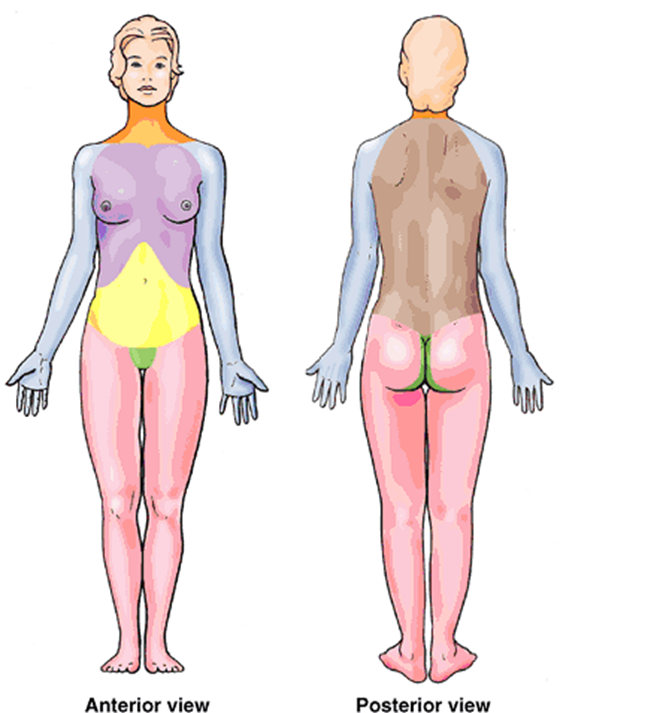
Ø Anatomical position is the position of a body universally used in anatomical descriptions in which the human body stands erect in upright position, the eyes looking forward to the horizon, the arms by the sides, and the palms directed forward, the lower limbs together with the feet directed anteriorly.
Image 1
Planes of the human body
There are three planes of the body.